The Vietnam War
Ideological warfare in the Vietnam region generated diplomatic conflicts after the invasion of the southern territory, under North-American domination, to the northern territory, dominated by the Soviets.
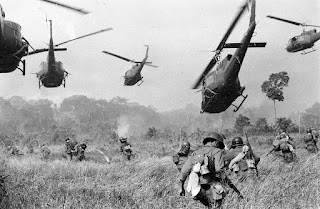
After North Vietnam crossed the parallel 17, a demilitarized zone, and attacked South Vietnam, tensions rise and the war, which had begun in 1955, still doesn't have an achievable resolution. The former French colony, known as Indochina, is located in Southeast Asia and, in 1940, during World War II, it was invaded by the Japanese Empire. Nationalist feelings led the Revolutionary League for the Independence of Vietnam (Vietmihn) trying, innumerous times, to declare the country's independence - but, only in 1945, after Japan's return and the end of the WWII, the claims would be done.
In 1946, the First Indochina War began as the republic created by the communists was installed in the region and, according to the Allies, that should’ve been occupied by the French. The Allies had defined a division of Vietnam from the so-called 17º parallel. China supported Ho Chi Minh, Vietnam’s president at that time, in the north, while the United States supported France, in the south. After the breach of the Treaty of Geneva (1954) by South Vietnam, which determined the temporary division of the country into north and south regions, and commanded popular elections to unify the nation in 1956, which ended up not happening, it was set the trigger for the Vietnam War.
Tomorrow, January 4th of 1973, the participating Nations of the United Nations Security Council (UNSC) were summoned to an emergency meeting to seek a resolution of the crisis in the Vietnam region. The countries convened for the conference were: Commonwealth of Australia, French Republic, People’s Republic of China, Republic of Austria, Republic of Guinea-Bissau, Republic of India, Republic of Indonesia, Republic of Kenya, Republic of Panama, Republic of Peru, Republic of the Sudan, Socialist Federal Republic of Yugoslavia, Union of Soviet Socialist Republics, United Kingdom and United States of America.
Failed attempts and Conferences had already been carried out with the aim of containing conflicts in the Indochina region, including Vietnam, such as the convening of the Geneva Conference in 1954. For this reason, it is expected that UNSC delegates will succeed, peacefully, resolve or alleviate the tensions generated in the region so that they will be able to respect their proper initial positions.

Comentários
Postar um comentário